A Loyalty Program Is a Way to Grow Spend, Not to Hand Out Discounts
A loyalty program for advertisers is a set of levels in the personal account. For spend, the advertiser gets privileges: a manager, priority moderation, API access, cashback, a credit line. Bronze, Silver, Gold and so on down the list. Networks love the Olympic scale of medals, but rarely explain what the medal is for.
The goal of such a program is not to say thank you to the advertiser. The goal is to show the next step and make it worth taking, for the network too: to spend more, for longer and more steadily with you, instead of spreading the budget across five others. For the network it is also a way to decide who gets a manager and how to keep an advertiser after a failed first launch.
I have written before that in a typical niche network 10 to 15 advertisers bring about 90% of turnover, while a manager formally splits attention across 45 to 50 accounts. A loyalty program is one way to turn that into rules.
A Level as a Barrier Before the First Campaign
The problem is that levels are often built around what is convenient for the network, not around the user's working day. And that day looks like this: move costs into the tracker, find the zones that burn budget, send them to the blacklist, raise bids on the ones that convert. All of it repeats every day, and the faster the loop, the cheaper the conversion. I described this loop in more detail in a separate article.
Three typical mistakes follow from this. First: locking behind a level what a buyer needs to feel safe launching a campaign, a blacklist for example, which is what lets the buyer buy everything that fits the targeting. Second: tying the level to money that is not revenue, for example the amount an advertiser tops up the account balance with. Third: handing out the most expensive resource, the account manager, to everyone.
My working hypothesis: a level helps advertisers grow if it shortens the buyer's loop or lowers the cost of the target action.
If a level hides tools instead, it can scare off the people who could have become your best advertisers.
Propeller Ads, RichAds and Evadav: What Works, What Scares People Off, What Hurts the Economics
I took three networks with public levels and analyzed their cabinets, official blogs and help centers. Everything below rests on public information, the kind an advertiser sees and, most likely, interprets the same way.
Propeller Priority
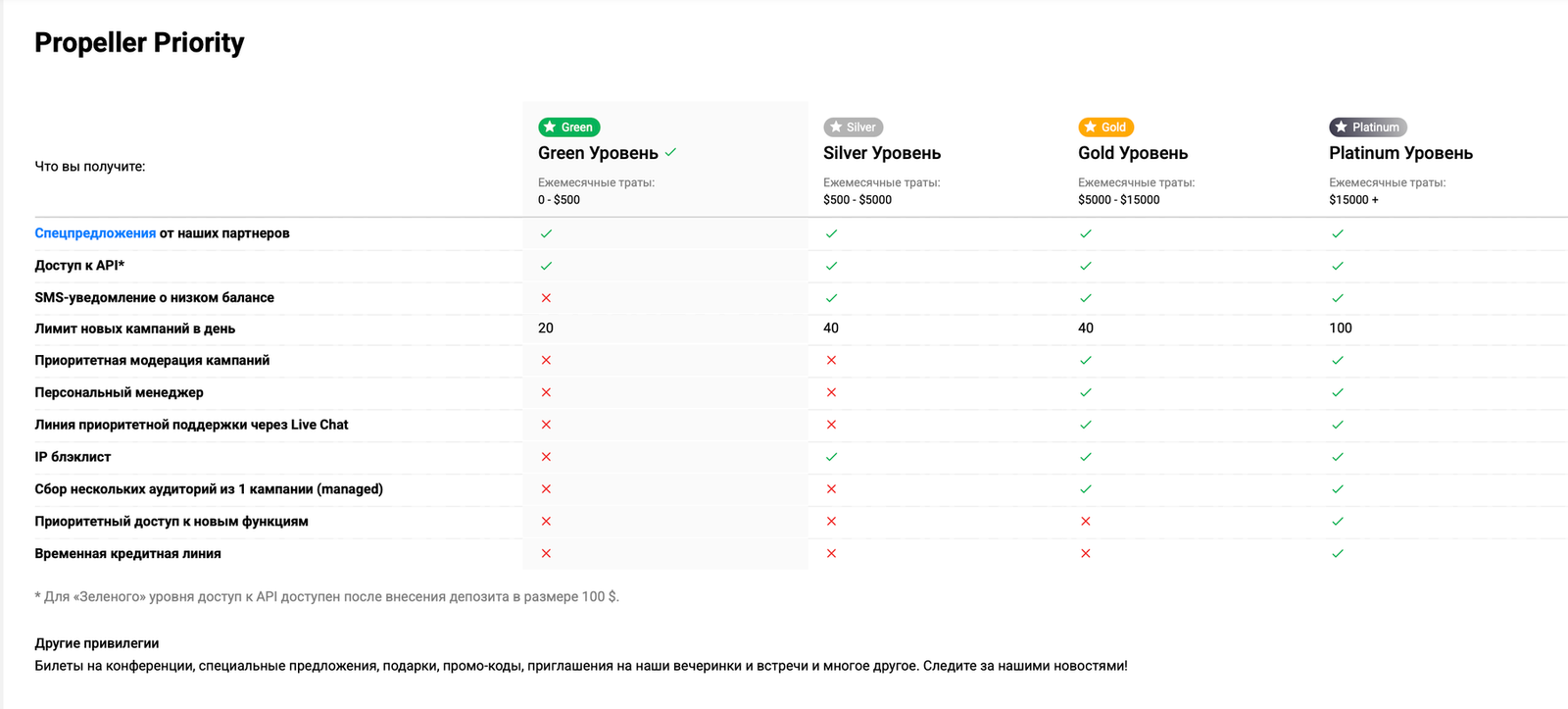
Four levels based on monthly spend: up to $500, up to $5,000, up to $15,000 and above. What works well: the API is available to everyone (on Green after a $100 deposit), there is a grace period before a downgrade (30, 60 and 90 days for Silver, Gold and Platinum), and traffic volume and bid levels are openly available, so an advertiser can estimate the potential before launching the first campaign.
The daily limit on new campaigns can give pause: 20 on Green, 40 on Silver and Gold, 100 on Platinum. But with the tools available in the cabinet from the start, it may not be a problem. A manager and priority moderation come only with Gold, that is from $5,000 a month, and Silver spans a tenfold range, so there is little to strive for inside it. For the network's economics this is the safest option: the service opens up when the advertiser is already paying.
RichAds
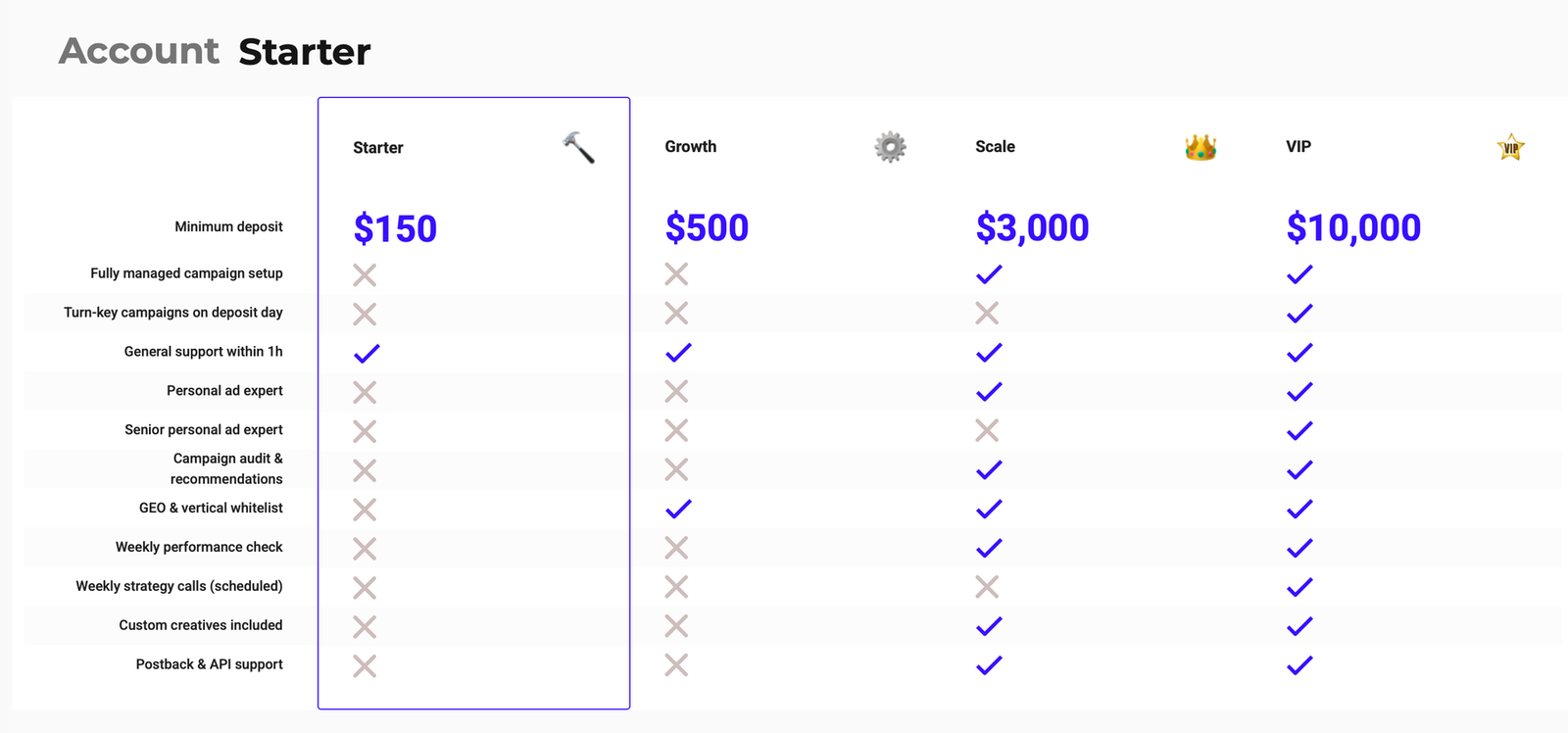
Four levels: $150, $500, $3,000 and $10,000. What works well: the tools are not locked. Auto-rules, micro bidding and Target CPA are available right after conversion postback from the tracker is set up. In other words, the program pays attention to behavior, not money. Moderation takes about 10 minutes. The service grows by steps: whitelist by GEO and vertical, then from Scale an expert, managed launch, audit and creatives, and on VIP a turnkey launch and weekly strategy calls.
What can scare people off is the $3,000 threshold before API access (the automation of a buyer's work in the tracker may depend on it), and the fact that between $500 and $3,000 almost nothing happens.
The economics are interesting too. The loyalty program is tied to the deposit level (the blog says "deposit or spend", so I could not confirm the exact rule), but the general policy under the Terms of Service is non-refundable: the balance remainder is not returned. So in terms of tools almost everything is available, but you have to commit to buying traffic. If after a $100 test the traffic does not convert, you cannot get the remainder back. That is friction. Is it worth putting in $150 or more? A full set of tools and fast support are good, but the balance can be frozen if the traffic does not work out.
Evadav
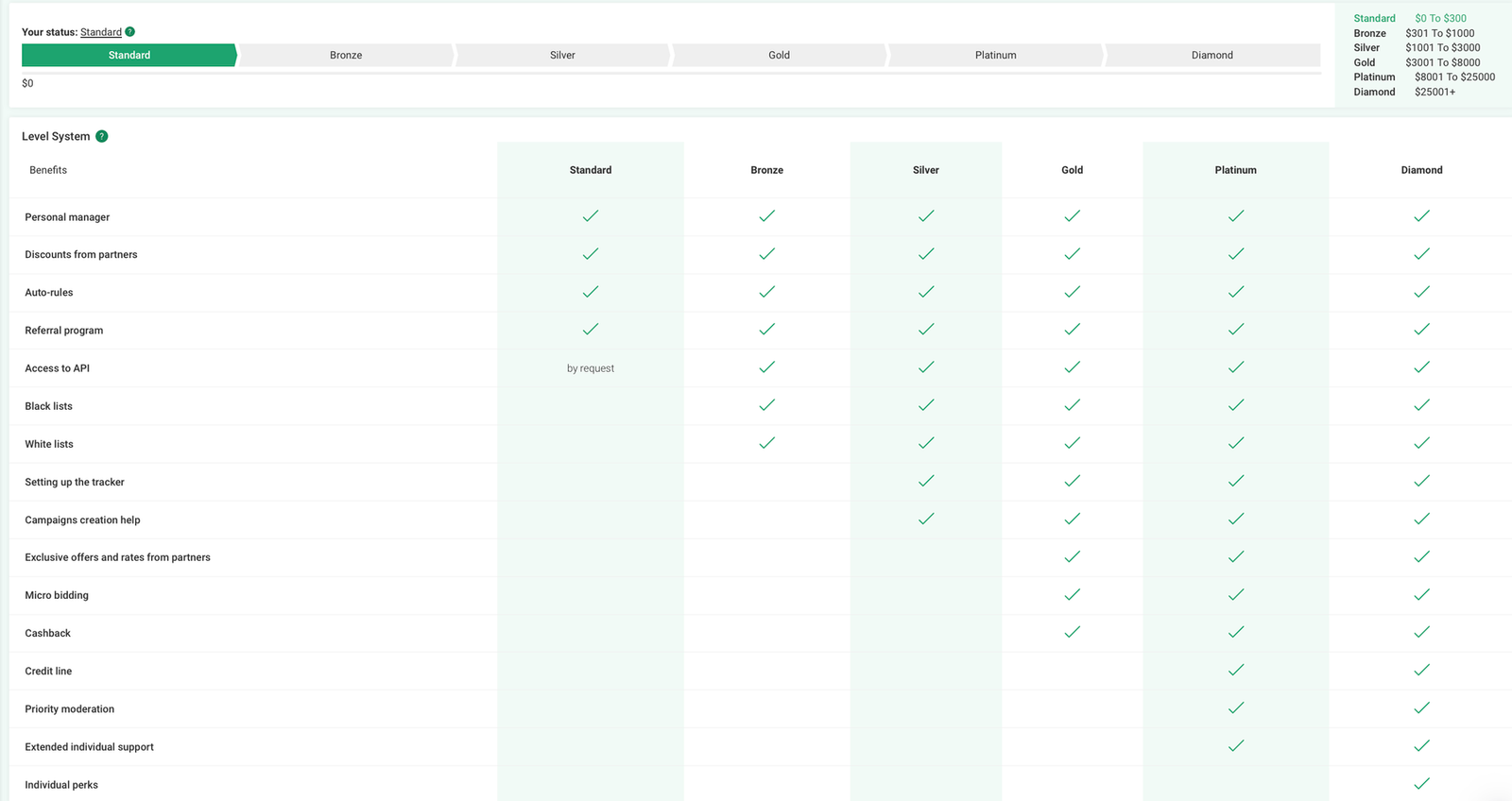
Six levels: $0 to $300, $301 to $1,000, $1,001 to $3,000, $3,001 to $8,000, $8,001 to $25,000 and above. What works well: the thresholds grow roughly threefold, so every goal feels equally reachable, and progress is visible in the cabinet. Platinum has a credit line with payment at the end of the month. For a buyer that is a serious thing: you pay for traffic upfront, while the money from the offer arrives later.
What scares people off is something else. The blacklist opens only from Bronze, that is after $301 of spend, which is almost the whole test budget of a newcomer. And there is a confusing point: in the level table auto-rules are available on all levels, but they work on the same principle as a blacklist, which is unavailable on Standard. I checked this while creating my first campaign. How it works in practice is not very clear, and that can put a user off. It looks like a promise without a way to use it. Bid per source (micro bidding) is Gold only, and I did not find a traffic chart.
What I did like is the cashback. The idea of rewarding advertisers based on their actual spend really appeals to me, and the mechanic of rewarding growth is fair too: in a promo it paid up to 5 to 6% of monthly spend at 10% growth over the previous period. An advertiser who steadily spends $8,000 and does not grow gets nothing. One more caveat: the official blog describes the thresholds as monthly, while in the cabinet they look cumulative. If they are cumulative, levels never go down, and over time most advertisers' status only goes up.
And there is a manager on every level, including Standard. This is exactly the equal-weight model I wrote about in the article on account management. The tail brings 1 to 2% of revenue, while a manager spends time on everyone. One review describes an Evadav manager as pushing for higher bids and spend (a single case, but the risk is structural). On the other hand, if this is a BDM level rather than an account manager, it is a good channel for finding and growing potentially large advertisers.
What Other Networks Do
A retro bonus or cashback is not very common. The closest example I found is VK Ads, which is not a niche network at all. It pays cashback of 5%, 7% and 10% for 1, 4+ and 7+ months of consecutive placement: a reward for consistency, not size. Galaksion has missions for using platform features.
Loyalty research says something similar: a goal works when it is close, 3 to 4 levels are enough, and when elite status goes to 25 to 30% of advertisers, it stops motivating.
A Four-Step Ladder That Does Not Get in the Way of Spending
Here is how I would build the program. The numbers below are illustrative: an example of the logic, not a recommendation.
Everything that shortens the buyer's loop is available from the first dollar: blacklists, auto-rules, a dedicated bid per zone, traffic volume and bids, and setting up conversion postback to the network. If something needs unlocking, tie it to behavior (for example a configured postback or a first test), not only to the account top-up.
A dedicated account manager is a scarce resource, and the threshold for it should sit where 80 to 90% of revenue sits. Below that, the manager is replaced by templated onboarding, a detailed FAQ and a chat with a guaranteed response time. A level is calculated from real spend over a rolling 90 days, with a grace period on a drop. A deposit is good only for a temporary 30-day status that has to be confirmed by spend.
There are two rewards: one for consistency (weeks or months in a row, as at VK) and one for growth, and both are paid out automatically, with no emails to support. Thresholds grow in steps of about 3×, and the first one sits roughly three times above the minimum deposit, so an advertiser reaches it within the first week or two.
In the example it looks like this. Start (up to $300 a month): all the loop tools, templated onboarding, a chat with an SLA. Growth (from $300): API with automatic cost upload and campaign management (zone optimization, bid changes), audiences, a small cashback for consistency. Scale (from $3,000): a manager or a pool with an SLA, priority moderation, a growth bonus. Key (from $10,000, or at the network's discretion for advertisers with high potential): a credit line based on payment history, early access to features, individual terms. Elite advertisers should be noticeably fewer than 25 to 30%.
Why this way. Access to all the tools removes friction at the start. A threshold before a dedicated manager lets the team focus on growing key advertisers. A rolling period with a grace window smooths out an arbitrageur's volatile spend. Two rewards do not punish the steady ones. Credit solves a real cash flow problem instead of just looking nice.
How to Build a Program for Your Network
Start with data. Export spend for 6 to 12 months and find the range that brings 80 to 90% of revenue. That is the threshold for a dedicated manager.
Then walk through a buyer's day on your own platform: what they do outside it and what is locked behind a level. Take everything from the loop off the levels. Choose 3 to 4 levels with a step of about 3×, define two rewards, and check how advertisers distribute across them.
After launch, watch the time to the first upgrade, spend spikes just before thresholds (a sign of gaming), and churn after a downgrade.
If you already have levels but spend does not grow from them, or there is no program at all, get in touch. I will review what scares people off in it and what is worth opening up earlier. Then I will build a version for your network, based on conversations with your own buyers, so that the program fits the advertisers of your network.